AI Speaking Coach for Intermediate English Learners: What Actually Helps
Stuck at intermediate? Why B1–B2 learners plateau in speaking, what an AI speaking coach should do about it, and which apps fit, including WitSpeak's limits.

Quick answer
Intermediate English learners usually understand far more than they can say. A good AI speaking coach makes you answer in full sentences, then shows what to fix in fluency, vocabulary, grammar and pronunciation, with a better version to repeat. WitSpeak (our product) is built for this; Loora, Praktika, ELSA Speak and human tutors are alternatives.
Disclosure: WitSpeak is our product. Other apps are described only from their own websites and store listings, checked on November 24, 2026; sources are at the bottom.
Stop learning new words for a week. That sounds wrong, but for most intermediate learners vocabulary is not what is missing. The Council of Europe describes B1 speakers as able to handle most travel situations and briefly give reasons for opinions, and B2 speakers as able to interact with enough fluency that conversation with native speakers works without strain for either side. The step from B1 to B2 is mostly about speed, range and control in speech, and you only build that by speaking.
Why intermediate learners plateau
- Safe sentences: you reuse the same simple structures because they feel safe, so your range stops growing.
- Translating in your head: you build the sentence in your first language first, which costs time.
- No one corrects you: friends and colleagues understand you, so they stop pointing out mistakes.
- Too little speaking time: classes and apps give you listening and reading, but few minutes of your own speech.
What an AI speaking coach should do at B1–B2
| Need | What good coaching looks like | Why it matters at B1–B2 |
|---|---|---|
| Longer answers | Open questions and roleplays that need 3–5 sentences, not one-word replies | Builds the connected speech B2 asks for |
| Feedback on the whole answer | Fluency, vocabulary, grammar and pronunciation, not only sounds | Plateaus are rarely about one dimension |
| A better version | Your own answer rewritten at a higher level, to say again | Shows the next step up from what you already said |
| Explanations you understand | Notes in your own language when English ones are too dense | Saves time on the hardest corrections |
| Pressure you can control | Timed answers, follow-up questions, less predictable partners | Trains speed without panic |
WitSpeak (our product): built for the intermediate gap
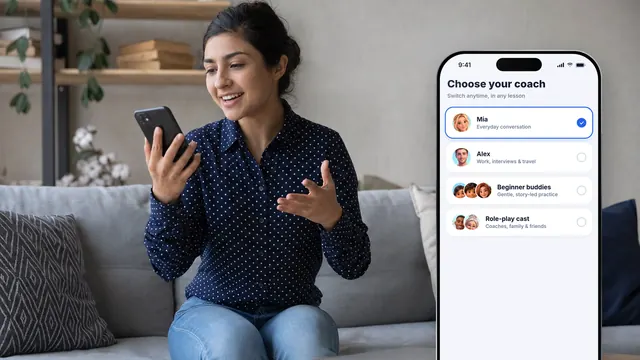
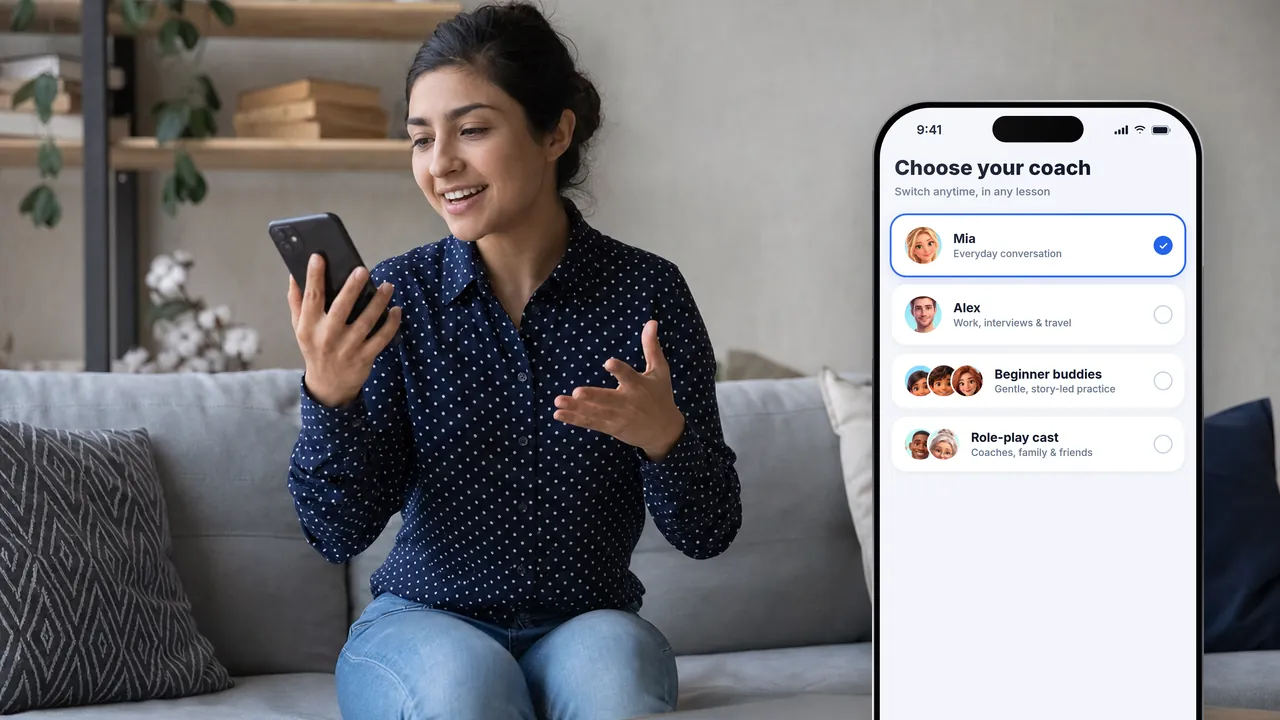
WitSpeak is a paid AI speaking coach for iPhone and Android, and the intermediate learner is who it is built for. You answer out loud in Free Talk with Mia or Alex, in 80+ adult roleplays such as a job interview or a disagreement in a meeting, in Rapid Fire for speed, and in IELTS-style questions with a live AI examiner. Each answer is scored on fluency, vocabulary, grammar and pronunciation, with a stronger version of what you said. Feedback can be explained in your own language (the app supports 44), and you can set your conversation level from A1 to C1.
Limits: band estimates are practice guidance, not official IELTS scores, and an AI coach does not replace a real conversation with a person. If you are below A2, start with a course app first.
Other good options
- Loora: its site describes an AI English tutor for conversations on any topic, including business meetings and job interviews, with real-time feedback on pronunciation, grammar, rephrasing and accent.
- Praktika: AI avatar tutors that, according to its site, can explain in your native language and correct pronunciation, grammar and word choice instantly.
- ELSA Speak: strongest if pronunciation is your bottleneck; its Google Play listing lists Conversation, Pronunciation and Grammar coaches plus career-specific practice.
- Speak: a guided course where you learn phrases, repeat them out loud and then use them with the Speak Tutor.
- A human tutor on italki: worth adding once a week for judgment, accountability and unpredictable conversation.
A two-week plan to break the plateau
- Days 1–3: answer the same three open questions every day. Read the feedback, then say the improved version out loud.
- Days 4–7: pick one weak dimension from your feedback and focus only on it, for example linking words for fluency.
- Days 8–10: roleplay one real situation from your work or life, three times, changing one detail each time.
- Days 11–14: add pressure. Use timed answers and follow-up questions, then record one answer to compare with day 1.
For a general method, read How to Practice English Speaking with AI. To compare English speaking apps side by side, see Best AI English Speaking Apps and which app gives instant feedback on spoken English.
Frequently asked questions
What is the best AI speaking coach for intermediate English learners?
One that makes you give longer spoken answers and corrects the whole answer, not only pronunciation. WitSpeak (our product) is built for this; Loora and Praktika offer open AI conversation with corrections, and ELSA Speak is strongest on pronunciation.
Why am I stuck at intermediate English speaking?
Usually because you understand much more than you produce. You reuse safe sentences, translate in your head and get little correction. More speaking time with specific feedback, and repeating improved answers, is what moves you forward.
Can an AI coach take me from B1 to B2?
It can give you the speaking volume and feedback that the step needs, but no app can promise a level. Track progress by recording the same task every two weeks, and get an official test if you need a certified level.
How much should an intermediate learner speak each day?
A short daily session you actually keep is better than a long one you skip. Aim for full spoken answers every session, and always repeat the improved version at least once.
Is WitSpeak free?
WitSpeak is a paid app; check the App Store or Google Play for the current offer in your country. The WitAccent English accent test on witspeak.ai is free and runs in the browser.
Sources
- Council of Europe: CEFR common reference levels, global scale (checked Nov 24, 2026)
- Loora official site (checked Nov 24, 2026)
- Praktika official site (checked Nov 24, 2026)
- ELSA Speak on Google Play (checked Nov 24, 2026)
- Speak official site (checked Nov 24, 2026)
- italki official site (checked Nov 24, 2026)